
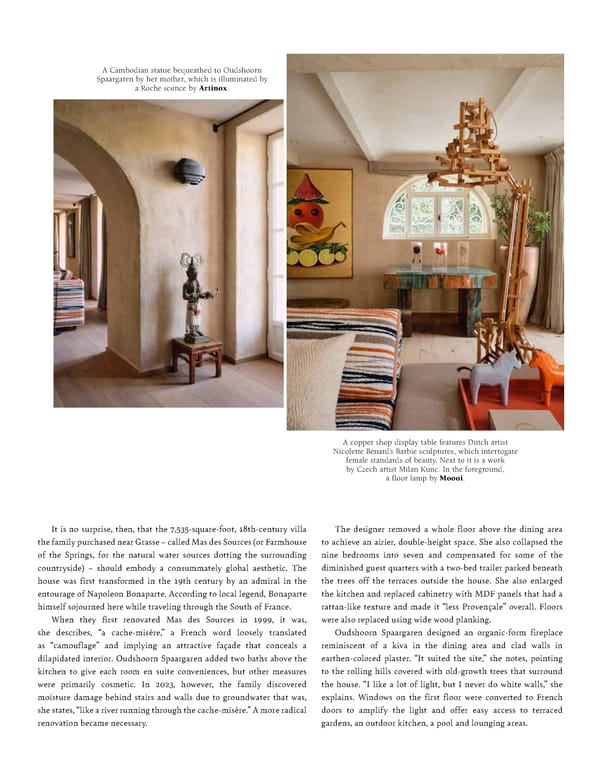
A Cambodian statue bequeathed to Oudshoorn Spaargaren by her mother, which is illuminated by a Roche sconce by Artinox . A copper shop display table features Dutch artist Nicolette Bénard’s Barbie sculptures, which interrogate female standards of beauty. Next to it is a work by Czech artist Milan Kunc. In the foreground, a floor lamp by Moooi . It is no surprise, then, that the 7,535-square-foot, 18th-century villa the family purchased near Grasse – called Mas des Sources (or Farmhouse of the Springs, for the natural water sources dotting the surrounding countryside) – should embody a consummately global aesthetic. The house was first transformed in the 19th century by an admiral in the entourage of Napoleon Bonaparte. According to local legend, Bonaparte himself sojourned here while traveling through the South of France. When they first renovated Mas des Sources in 1999, it was, she describes, “a cache-misère,” a French word loosely translated as “camouflage” and implying an attractive façade that conceals a dilapidated interior. Oudshoorn Spaargaren added two baths above the kitchen to give each room en suite conveniences, but other measures were primarily cosmetic. In 2023, however, the family discovered moisture damage behind stairs and walls due to groundwater that was, she states, “like a river running through the cache-misère.” A more radical renovation became necessary. The designer removed a whole floor above the dining area to achieve an airier, double-height space. She also collapsed the nine bedrooms into seven and compensated for some of the diminished guest quarters with a two-bed trailer parked beneath the trees off the terraces outside the house. She also enlarged the kitchen and replaced cabinetry with MDF panels that had a rattan-like texture and made it “less Provençale” overall. Floors were also replaced using wide wood planking. Oudshoorn Spaargaren designed an organic-form fireplace reminiscent of a kiva in the dining area and clad walls in earthen-colored plaster. “It suited the site,” she notes, pointing to the rolling hills covered with old-growth trees that surround the house. “I like a lot of light, but I never do white walls,” she explains. Windows on the first floor were converted to French doors to amplify the light and offer easy access to terraced gardens, an outdoor kitchen, a pool and lounging areas.
 aspire design and home Spring 2026 Page 86 Page 88