
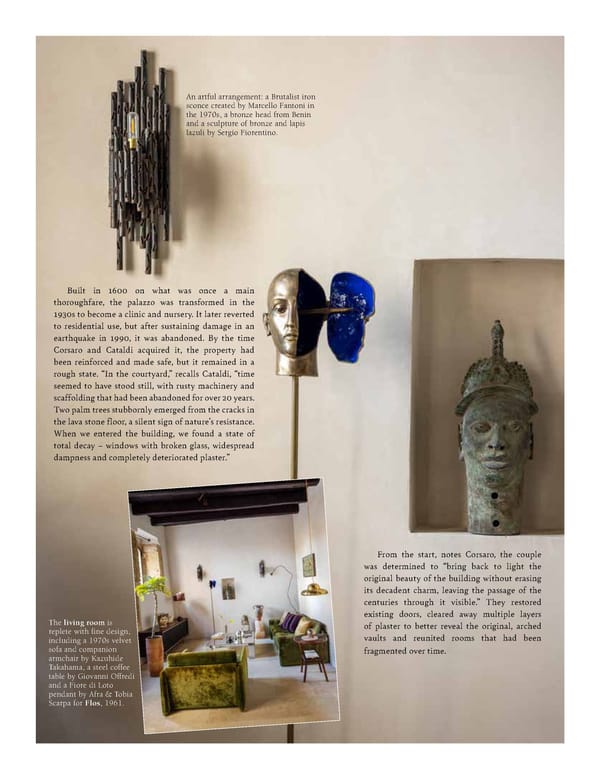
The living room is replete with fine design, including a 1970s velvet sofa and companion armchair by Kazuhide Takahama, a steel coffee table by Giovanni Offredi and a Fiore di Loto pendant by Afra & Tobia Scarpa for Flos , 1961. An artful arrangement: a Brutalist iron sconce created by Marcello Fantoni in the 1970s, a bronze head from Benin and a sculpture of bronze and lapis lazuli by Sergio Fiorentino. Built in 1600 on what was once a main thoroughfare, the palazzo was transformed in the 1930s to become a clinic and nursery. It later reverted to residential use, but after sustaining damage in an earthquake in 1990, it was abandoned. By the time Corsaro and Cataldi acquired it, the property had been reinforced and made safe, but it remained in a rough state. “In the courtyard,” recalls Cataldi, “time seemed to have stood still, with rusty machinery and scaffolding that had been abandoned for over 20 years. Two palm trees stubbornly emerged from the cracks in the lava stone floor, a silent sign of nature’s resistance. When we entered the building, we found a state of total decay – windows with broken glass, widespread dampness and completely deteriorated plaster.” From the start, notes Corsaro, the couple was determined to “bring back to light the original beauty of the building without erasing its decadent charm, leaving the passage of the centuries through it visible.” They restored existing doors, cleared away multiple layers of plaster to better reveal the original, arched vaults and reunited rooms that had been fragmented over time.
 aspire design and home Spring 2026 Page 102 Page 104